
Boone Projected vs Actual Release Dates
A projected date is a calculation based on the sentence record and facts known at that time. An actual date records a completed custody movement. The two can differ because of a court order, sentence credit, Board action, misconduct, holds, transfers, or recalculation.
A pretrial Boone detainee usually has no calculable sentence release date. Bond, recognizance, dismissal, plea, trial, or another court action controls the next step. A court entry can explain authority but does not prove the time a person crossed the jail door. Mandatory counts and emergencies can delay movement after a legal event.
A sentenced county-jail detainee has a calculation based on the judgment, jail credit, holds, and jail administration. No official Boone source reviewed publishes a universal county good-time formula or weekend-release rule. Do not apply state-prison formulas to a county sentence.
Find a Boone County Release Date
Identify the custody system first. A Boone booking and a later MODOC prison term are different records, even when they concern the same case.
- Check Boone Current Detainees to see whether the person remains listed at the report time.
- For a pretrial matter, review Case.net for bond, dismissal, plea, judgment, and future events.
- For a county sentence, call the Boone Records Unit at 573-875-1111 extension 6128 and ask for the jail calculation and holds.
- For a state prisoner, search the active MODOC portal, then examine the nightly Sunshine sentence data.
- Reconcile all concurrent and consecutive sentences, completed flags, cause numbers, and special codes.
- Confirm a projected date with the institutional parole office and the actual exit with the releasing agency.
The Boone County release search guide gives the complete Sheriff request route when a roster cannot answer the question.
Missouri Conditional Release Calculations
Section 558.011 divides covered felony terms into prison and conditional-release portions. The conditional portion is one-third for sentences of nine years or less, three years for terms above nine through fifteen years, and five years for longer terms. The prison term is the remainder.
Conditional release is supervised discharge under Parole Board authority, not unconditional completion. The Board can extend the conditional-release date, up to the full sentence, through the statutory process for institutional rule violations. Dangerous felonies and fourth-or-subsequent DOC remands are excluded from the ordinary split.
Note: A statutory calculation sets a framework; it does not guarantee departure on the first eligible day.
Section 217.690 also makes parole discretionary. Guidelines can frame eligibility, but they neither guarantee a release date nor reduce the court’s sentence.
Boone Cases and the 85 Percent Rule
Missouri does not require every prisoner to serve 85 percent. Section 558.019 generally applies that minimum to a dangerous-felony sentence as defined in § 556.061, subject to the current statute’s older-offender alternative. It also contains separate minimum terms for listed non-dangerous offenses based on prior DOC commitments.
These are minimum eligibility rules for parole, conditional release, or another early DOC release. Eligibility is not an order to release. The current offense list, conviction date, prior commitments, and exceptions must be checked against the actual judgment. Do not apply the shorthand to a pretrial detainee, a Boone county-jail term, or every MODOC case.
Why Boone Release Dates Change
A projected date moves when the facts or legal authority behind it change. Read the whole custody and sentence record rather than one field.
| Factor | Possible effect | Verify with |
|---|---|---|
| Concurrent or consecutive terms | Changes how sentences combine | Judgment and all DOC rows |
| Court amendment or credit | Changes the term or credited time | Clerk and jail or DOC calculation |
| Institutional violation | May extend conditional release | Institution and Parole Board |
| Board action | May set, defer, or change a future date | Board or parole office |
| Hold or detainer | Can prevent community release or cause transfer | Custody record and receiving agency |
| Recalculation or special code | Can replace an apparent date | MODOC calculation record |
A name disappearing from one roster also may mean transfer. Only the release reason and destination distinguish community release from continued custody elsewhere.
Boone Minimum and Maximum Date Fields
MODOC’s nightly Sunshine file publishes Sentence-I Minimum Release Date and Sentence Maximum Release Date. The first is the calculated minimum on an active sentence. The second is the maximum release or expiration date for that sentence. Neither alone is necessarily the actual prison exit.
The file uses 99999999 for life, 88888888 for indeterminate or interstate sentences, and 66666666 for a field-supervision court assessment or investigation. These codes are not calendar dates.
The official MODOC Sunshine source explains the former and current offender data:
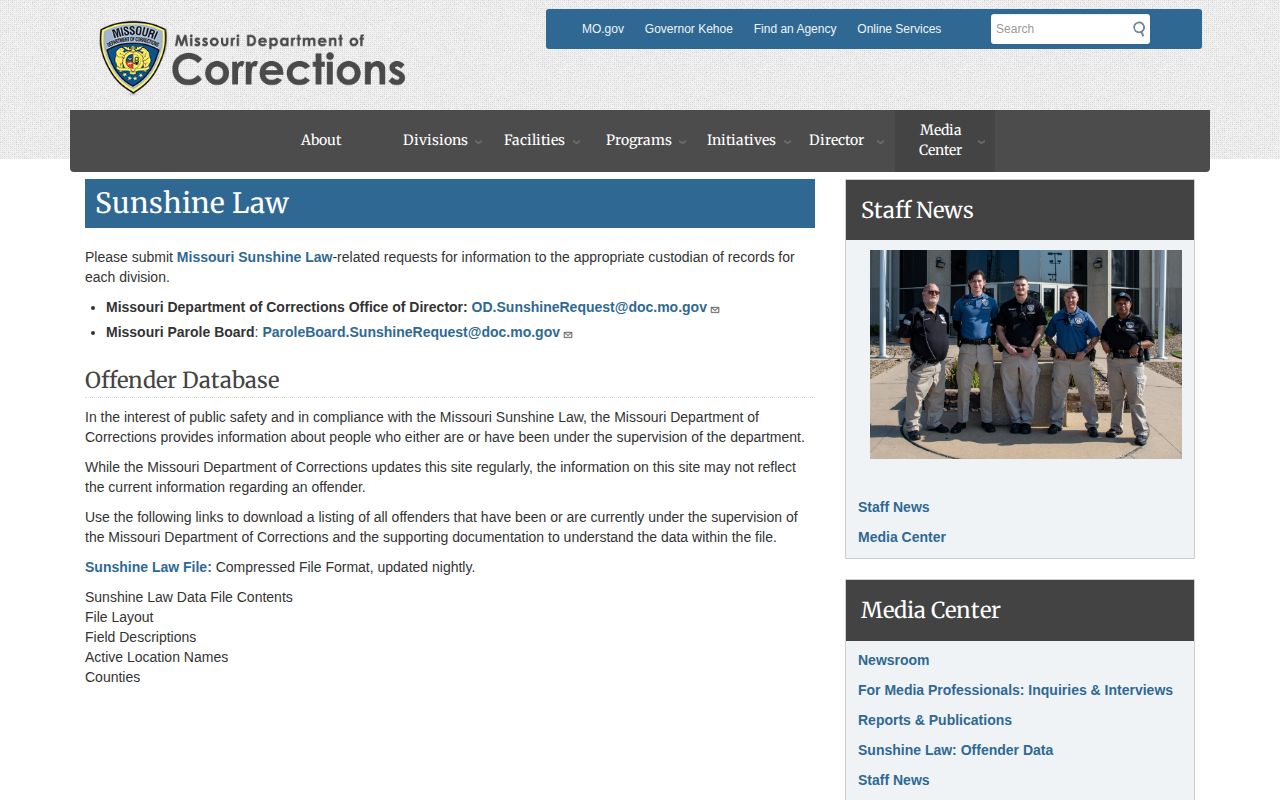
Group every matching row by DOC ID, then compare cause number, sentence county, completion, and location. A Boone sentence county means the Boone court imposed the term, not that Boone County Jail controls it.
Community Credit Is Not Prison Good Time
Section 217.703 gives eligible people on probation, parole, or conditional release thirty days of supervision reduction for each full compliant calendar month. Credit stops during custody, violations, suspension, or absconder periods. A court or Board orders final discharge when the conditions are met.
This credit shortens eligible community supervision after release. It does not move the prison-gate date. Mixing it with conditional release or a minimum prison term produces a false projection.
Confirm a Boone County Release Date
For Boone County Jail, use the Sheriff records form to ask for the booking/release sheet or custody-movement history with admission, release, reason, and destination. For MODOC, ask for the sentence calculation and later release or discharge record. Use the court docket to explain legal authority without treating it as an exit log.
Missouri MOVANS can alert by SMS or email to a custody or court change. The VINELink Release Check explains the current Boone workflow. An alert still needs confirmation because it may report transfer or another agency event.
Send public DOC requests to OD.SunshineRequest@doc.mo.gov. Include full name, DOC or booking number, cause number, and date range, and ask for the precise record supporting the date. For jail calculations, use Boone Records Unit. These source records are stronger than an estimate or a missing portal result.
Read Boone Sentence Data Carefully
A single future date may belong to one sentence row rather than the whole case. MODOC’s Sunshine file can contain several charge records for one person, with cause number, offense and sentence county, completed flag, concurrent or consecutive indicator, sentence date, sentence length, and minimum and maximum dates. Start with the lifetime DOC ID and group all rows before interpreting any date.
Concurrent terms may run together, while consecutive terms may extend the controlling calculation. A completed flag on one row does not show that the other terms are complete. Likewise, an F field location can identify community supervision while an I location identifies an institution function. Location and sentence data must be read together.
Use Sentence County = Boone to identify a Boone court-of-record sentence. It does not show that the person is in Boone County Jail or that a Boone office calculated the prison date. The judgment from the 13th Judicial Circuit and the MODOC calculation answer different parts of the question.
The active MODOC search is narrower. It covers active offenders, including probationers and parolees, and expressly excludes discharged offenders. The person-level view is CAPTCHA-gated, and the research did not independently verify a universal future-date label. Do not promise that every active result displays a projected, conditional, or actual release date.
When the calculation concerns parole, distinguish eligibility from Board action. A hearing can lead to another hearing in one to five years or a future release date, and the decision usually takes about eight to twelve weeks. Board guidelines may set expectations, but § 217.690 preserves discretion. Only a duly adopted order establishes the Board result.
Boone Jail Dates vs Prison Dates
A Boone detainee awaiting trial usually cannot be assigned a sentence release date because the court has not imposed the controlling term. Bond can be posted around the clock at the public jail entrance, but a bond action and physical exit need not share a timestamp. Four mandatory counts and emergencies can briefly restrict movement.
For a sentenced county-jail term, ask the Jail or Clerk for the judgment, jail credit, holds, and calculation used. Research found no general Boone good-time formula and no published weekend-release policy. That absence is a reason to request the actual calculation, not permission to import a formula from another Missouri county or MODOC.
If the Boone record shows commitment to MODOC, the event is a transfer from county custody rather than community release. The state sentence framework then controls. If the record shows an out-of-county, federal, or immigration hold, the receiving agency’s custody system controls what happens next. A roster disappearance alone resolves none of these paths.
After release, parole or conditional release may continue under MODOC legal custody. Earned compliance credit may later shorten eligible community supervision, but that later discharge should never be reported as the original prison release date. Keep physical exit, active supervision, and final discharge as three separate milestones.
Case.net is useful for checking whether the Boone judgment has changed. Review the case number, judgment, amended judgment, jail credit, bond, and later docket entries. A court order can change the legal basis for a calculation, yet the court docket may not show the institution’s processing time or an outside hold. Supply the amended order to the jail or MODOC when asking for a recalculation.
For a formal request, identify the person, DOC or booking number, Boone cause number, sentence date, and date range. Ask for the current calculation worksheet or public sentence-calculation record, the source of each credit, any controlling hold, and the date the agency last recalculated the term. Request an estimate before production. A dated agency response makes it clear that the result is a snapshot, not a permanent promise.
Once the expected day arrives, verify the completed movement separately. The Boone record should state release time, reason, and destination. The MODOC record should distinguish release to parole or conditional release from final discharge. If another agency took custody, continue with that agency rather than reporting a community release. This final check is essential because a mathematically correct projection can still differ from the actual custody outcome.